Showing posts with label UbuWeb. Show all posts

Stan Douglas, Broadcast Works

1 comments


Stan Douglas Broadcast Works: Television Spots and Monodramas
1987 - 1991
7 minutes 51 seconds

"I hope to be surprised by the meanings that these works can generate, so that by putting the right materials together, they can do more or result differently from what I expected. This process is opposed to metaphorical constructions, where artists expect to control the meaning of a work by defining how it is to be read symbolically. I want to work with what an image means in a public world. So when people bring their understanding of how images work, and how things are in the world, they can do something completely different from what I anticipated when I put them together."
Taken from the UbuWeb archive, artist Stan Douglas' Broadcast Works were originally created to be inserted unannounced amongst the regular programming schedule and in advert breaks on a Canadian TV station. Seconds-long and intentionally ambiguous and open ended, viewers ended up responding to the videos by calling the station to find out what they were.

The Television Spots (1987/88) are Becket-like constructions depicting banal and incidental non-events in which our expectations of a focal point or conclusion are conflated when the piece comes to an abrupt end. More developed, and slightly longer at between 10 and 30 seconds each, the Monodramas (1991) appear like ads without branding or inconclusive snippets from a larger narrative.

Fullscreen here.
More Stan Douglas videos here.

Quote from Stan Douglas in Conversation with Diana Thater, from Stan Douglas, Phaidon 1998.

Marcel Duchamp's Problem With No Solution

3 comments
White to Play and Win

In 1943 gallery owner Julien Levy invited Marcel Duchamp, Joseph Cornell and Yves Tanguy to present a selection of miniature artworks in an exhibition entitled Through The Big End Of The Opera Glass. Asked to each submit an image for inclusion on the exhibition announcement card, Duchamp - a world-class chess player - created the problem shown above, printed backwards with the instruction 'White to Play and Win'. To an even moderately experienced player it seems as though White will surely be able to win (crossing the pawn currently positioned on the B7 square to gain an advantage by promoting to a queen).

Printed on the reverse Duchamp included a hand-drawn image of Cupid, it's arrow pointing to the B file when one follows the written instruction, "Look through from the other side against light," and the images are overlaid with the chess board now right-side round (a black square in the bottom left - below). However, rather than indicating a solution, this merely adds to the image's ambiguity. Attracting much analysis, many experts have concluded that this problem, in fact, has no solution. Exhibiting his trademark mischievous and playful sense of humour, the artist clearly anticipated the hours many chess journalists and even Grandmasters would spend pouring over the quandary to no avail.


As Francis Naumann concludes in the below linked article:
The rigor and intensity of this endgame problem stands in sharp contrast to the means by which Duchamp presents us with a hint of its solution: a cupid aiming his arrow toward the ground (or into the sky, if we consider that the cupid is presented upside-down). Cupid is, of course, the mythological god of love, and his arrow is usually aimed in the direction of an amorous target; a direct hit can cause the recipient to fall deeply and blindly in love. Knowing this, and knowing that when Duchamp designed this brochure he had recently met and fallen in love with Maria Martins— a Brazilian sculptor, married with three children, and in almost every respect, unattainable—one is tempted to speculate that Duchamp might have had a personal situation in mind when he decided that a cupid should indicate the path to follow in pursuing a solution to this vexing problem. Duchamp was well known for having said: “There is no solution, because there is no problem.” In the end, the problem that he faced with Maria Martins was insurmountable, demonstrating that in both chess and life— and perhaps in art as well—there are, indeed, problems without solutions.
Problems which are, never-the-less, compelling, all-consuming and deeply engrossing.

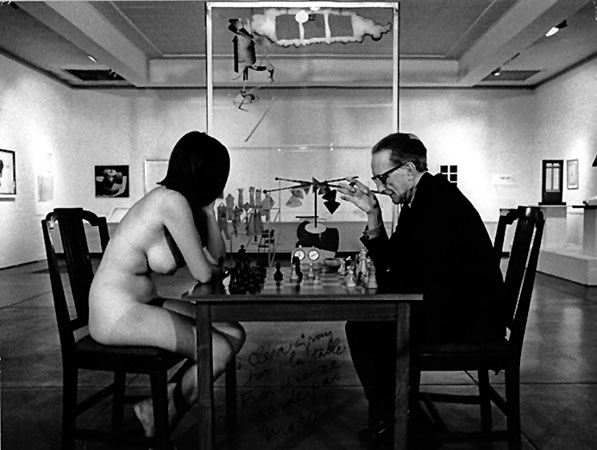
For more on Duchamp the Chess Player I heartily recommend watching the excellent and enthralling Jeu D'Échecs Avec Marcel Duchamp (1963) from UbuWeb's extensive video archive, in which the artist plays the game with avant-garde composer Edgar Varese and discusses his work.

For more on Duchamp's Problem With No Solution click here.

Mark Leckey, Fiorucci Made Me Hardcore

0 comments


Mark Leckey Fiorucci Made Me Hardcore 1999

Fullscreen version here.

Continuing on a bit of a rave theme, here's another gem from the UbuWeb film archive.

Taking
Elio Fiorucci's iconic Italian fashion label as a point of reference, Leckey's Fiorucci Made Me Hardcore is a video exploring myriad forms of youth culture and fashion emerging and evolving in Britain in the 70s, 80s and 90s. Created through a process of appropriating, manipulating and editing home-video footage, we are treated to a reveler's-eye-view of a progressing procession of discos, dances, raves and their attendees.

Dan Graham, Performer/Audience/Mirror

0 comments


Dan Graham Performer/Audience/Mirror
1975
B & W, 23 minutes
From UbuWeb.
For full screen version click here.

UbuWeb is a vast non-commercial online resource of avant-garde material. They have one of the largest archives of sound and video works on the web, all available to view without charge or registration. I will be posting personal favourites from the archive over the coming weeks and months.

This first posting is an unfortunately incomplete video document of a Dan Graham performance from 1975.

Text from UbuWeb:
"This work is a phenomenological inquiry into the audience/performer relationship and the notion of subjectivity/objectivity. Graham stands in front of a mirrored wall facing a seated audience; he describes the audience's movements and what they signify. He then turns and describes himself and the audience in the mirror. Graham writes: "Through the use of the mirror the audience is able to instantaneously perceive itself as a public mass (as a unity), offsetting its definition by the performer ('s discourse). The audience sees itself reflected by the mirror instantly while the performer's comments are slightly delayed. First, a person in the audience sees himself 'objectively' ('subjectively') perceived by himself, next he hears himself described 'objectively' ('subjectively') in terms of the performer's perception.""

 
Copyright 2010 ///////Postproduced