I don't really use this blog any more, though maybe I will do one day.
Please see my other blog, Open File, which I tend to use nowadays.
John Russell, Vermillion Vortex
Labels:
Contemporary art,
John Russell,
Video,
Video Art
0
comments
John Russell Vermillion Vortex
2010
23 minutes
Former Bank member, John Russell's new video work, commissioned by Art Review for their November 2010 issue.
High quality version here.
High quality version here.


Moon Wiring Club, The Jayston Mix
Labels:
Clark,
Electronic Music,
Experimental Music,
kpunk,
Moon Wiring Club,
Mordant Music,
Music
0
comments

Oh! A new mix by Moon Wiring Club from a wonderful new discovery, Pontone, an excellent independent music site. Coinciding with the release of their new album, A Spare Tabby At The Cat's Wedding, an album released as a 2-part vinyl and CD coupling, Moon Wiring Club venture out of Clinkskell to share some more self-confessed silliness in a mix dedicated to English actor Michael Jayston.
Ian Hodgson's output as Moon Wiring Club takes us on a creepy and somewhat confusing adventure into the imaginary world of Clinkskell, home to Gecophonic Productions and a host of unusual characters. Through the website, full of texts and illustrations painting a picture of this lost and timeless place, and a series of recorded releases and mixes, Hodgson invites us into an imaginative fictitious place filled with references to the past, occult explorations and pop cultural borrowings from the '70s and '80s.
Initial rummaging round the Pontone archives also turned up mixes by Clark, kpunk and Mordant Music.
Mark Fisher Talk at Chisenhale Gallery

Wednesday 17th November 2010
7 pm Free
Alongside Hito Steyerl's new exhibition at Chisenhale, Mark Fisher, author of Capitalist Realism, known to many as blogger kpunk, presents a talk in which he asks the question: ‘Can anything genuinely new emerge in a political landscape that is clogged with ideological junk?’
Mike Nelson, The Coral Reef, Tate Britain, London
Labels:
Exhibition,
Listings,
London,
Mike Nelson,
Tate Britain,
The Coral Reef
0
comments

Mike Nelson The Coral Reef
Tate Britain
Millbank, London, SW1C 4RG
10am - 6pm daily
Free
Mike Nelson's The Coral Reef is currently on show as part of Tate Britain's collection displays.
Having first been exhibited at Matt's Gallery in 2000, 10 years on it remains one of the most strikingly original pieces of contemporary art you could wish to see. It is an immersive installation that takes the form of a labyrinthine construction of rooms and passage ways in which carefully placed objects act as clues to the characters that have recently left.
The experience of walking through it is disconcerting and unsettling while also being rewarding and full of entertaing surprises - make sure you've got a few 10 pence pieces with you as the arcade machine really works, and watch out for rooms that seem familiar, they may be exact copies of others...
The Nelson installation is worth the trip on its own, but be sure to take a look at Fiona Banner's breathtaking new commission for the Duveen Gallery, Harrier and Jaguar, while you're there, and also catch Francis Alÿs' Guards in the Lightbox space downstairs.
John Bock, Curve-Vehicle incl. Π-Man-(.), Barbican Curve, London
Labels:
Barbican Curve,
Contemporary art,
Exhibition,
John Bock,
Listings,
London
0
comments

Barbican Curve
Barbican Centre, Silk Street, London, United Kingdom EC2Y 8DS
10th June - 12th September 2010
Daily 11am - 8pm, Thursdays until 10pm
Free
John Bock's practice is a visually stunning amalgam of sculpture, assemblage, performance and video that traverses the mundane, the absurd and the grotesque in a reference-laden language that is seductive, exciting and at times unsettling. Inhabiting the Barbican's large, curved gallery is a series of sculptures taking the form of ceiling- and wall-mounted 'parasites' - pod-like living spaces whose insectoid limbs break through the space's walls - and a large vehicle echoing the forms of these in a tower of pods mounted atop a taxi chassis.Barbican Centre, Silk Street, London, United Kingdom EC2Y 8DS
10th June - 12th September 2010
Daily 11am - 8pm, Thursdays until 10pm
Free
Having opened last week minus a film of one of Bock's 'lectures' - the artists' preferred name for his performance works, one of which is currently being made in the space- the exhibition is due for completion by this Saturday, 19th June and is certainly not to be missed.
Photocredit Lyndon Douglas.
Gig: Patten, Arch M, Forest Creature & Kaleidoscope DJs, 18th June, The Woodmill, London
Labels:
Arch M,
Experimental Music,
Forest Creature,
Gig,
Kaleidoscope,
Listings,
London,
Music,
Patten,
The Woodmill
0
comments
 Click to enlarge.
A fundraiser at one of South East London's newest studio and gallery complexes, The Woodmill. Expect glitches, beeps and lush, off-kilter electronics from Patten, Arch M, Sheffield's Forest Creature, Kaleidoscope DJS and more.
Stan Douglas, Broadcast Works
Labels:
1980s,
1990s,
Becket,
Contemporary art,
Stan Douglas,
Television Spots/Monodramas,
UbuWeb,
Video,
Video Art
1 comments
Stan Douglas Broadcast Works: Television Spots and Monodramas
1987 - 1991
7 minutes 51 seconds
"I hope to be surprised by the meanings that these works can generate, so that by putting the right materials together, they can do more or result differently from what I expected. This process is opposed to metaphorical constructions, where artists expect to control the meaning of a work by defining how it is to be read symbolically. I want to work with what an image means in a public world. So when people bring their understanding of how images work, and how things are in the world, they can do something completely different from what I anticipated when I put them together."
Taken from the UbuWeb archive, artist Stan Douglas' Broadcast Works were originally created to be inserted unannounced amongst the regular programming schedule and in advert breaks on a Canadian TV station. Seconds-long and intentionally ambiguous and open ended, viewers ended up responding to the videos by calling the station to find out what they were.
The Television Spots (1987/88) are Becket-like constructions depicting banal and incidental non-events in which our expectations of a focal point or conclusion are conflated when the piece comes to an abrupt end. More developed, and slightly longer at between 10 and 30 seconds each, the Monodramas (1991) appear like ads without branding or inconclusive snippets from a larger narrative.
Fullscreen here.
More Stan Douglas videos here.
Quote from Stan Douglas in Conversation with Diana Thater, from Stan Douglas, Phaidon 1998.
The Television Spots (1987/88) are Becket-like constructions depicting banal and incidental non-events in which our expectations of a focal point or conclusion are conflated when the piece comes to an abrupt end. More developed, and slightly longer at between 10 and 30 seconds each, the Monodramas (1991) appear like ads without branding or inconclusive snippets from a larger narrative.
Fullscreen here.
More Stan Douglas videos here.
Quote from Stan Douglas in Conversation with Diana Thater, from Stan Douglas, Phaidon 1998.
The End Is Nigh! Apocalyptic Visions In East London
Labels:
All Suffering SOON TO END,
Chisenhale Gallery,
Contemporary art,
Jennet Thomas,
Matt's Gallery,
Melanie Gilligan,
Popular Unrest,
Review,
Video Art
0
comments
A recent trip along the Regent's Canal to two of East London's best contemporary art spaces led me into two dark, apocalyptic video installations filled with the terrors of imminent catastrophe: Jennet Thomas's All Suffering SOON TO END! at Matt's Gallery (currently in its final week) and Melanie Gilligan's Popular Unrest at The Chisenhale.
 Jennet Thomas All Suffering SOON TO END!
Matt's Gallery
42–44 Copperfield Road, London E3 4RR
April 14th - June 6th 2010
Wednesday - Sunday 12 - 6 pm
Screenings begin on the hour and at 30 minutes past
Jennet Thomas's All Suffering SOON TO END! is a two-part installation based around the end-of-world predictions disseminated in an evangelical Christian pamphlet delivered to the artist. Extrapolating from the Revelations-esque Last Days prophecies, Thomas has created a menacing character in the form of The Purple Preacher - a combination of an imagined embodiment of the writer of the pamphlet and the Marvel Comics villain, The Purple Man, a character who possesses the ability to control enemies through incredible powers of persuasion.
The 30 minute video features The Preacher paying a visit to an elderly couple and detailing the evidence that our increasingly secular world has lead to an enormous increase in the amount of suffering experienced by humankind, that we have angered God by ignoring Him and that he is punishing us for this. But do not worry - for all this suffering is to end very soon, thanks to His salvation. Following this, a car journey and a rather unnerving trip to a model village with a stern Green Nun character, and a few poorly performed musical numbers act as features of The Preacher's evangelical repertoire, before life-sized living dolls of Adam and Eve wreak havoc in the pensioners' home and attempt to recruit school children to the cause.
Strangely (probably unintentionally?) reminiscent of absurdist left-field comedy sketch shows such as Big Train and Chris Morris's Jam, the video is blackly comic and by turns quite unsettling and somewhat endearing. Spliced with flashes of destruction and doom, the video meanders through repeated scenes of the purple figure preaching his message, edited to a soundtrack of pulsing glitches, ambient electronics and reverberating dialogue. Images of a hypnotic TV screen featuring an animated motif reminiscent of both a cross and that biblical root of sin, the Tree Of The Knowledge Of Good And Evil. The image becomes central to the work's visual language when it recurs in filled-out sound-emitting three-dimensional form as the centre-pieces of the adjoining installation.
The film is compelling and at its heart thoroughly enjoyable, creating a comical parody of these doom and gloom religious ramblings. It manages to do what good satire does best, and subverts what is actually in real life a scary and sinister practice (frightening the elderly and indoctrinating the young) into a ridiculous and bizarre farce.
 Melanie Gilligan Popular Unrest
 Chisenhale Gallery
64 Chisenhale Road, London, E3 5QZ
7th May - 20th June 2010
Wednesday to Sunday 1 – 6pm
Thursday 3rd June until 9pm
64 Chisenhale Road, London, E3 5QZ
7th May - 20th June 2010
Wednesday to Sunday 1 – 6pm
Thursday 3rd June until 9pm
And online at http://www.popularunrest.org/
Taking on the form of an episodic drama the series tells the tale of a not-too-distant future in which a digitised system known as The Spirit monitors and manages human life the world over. As the plot unravels we learn of a mysterious spate of killings being carried out across London by a seemingly super-natural force, and of a bizarre phenomenon arising across the country in which groups of people are mysteriously drawn together by an uncontrollable urge to be with one another. I won't say any more about the plot for fear of spoiling the suspense of the work for you if you see it yourself.
Reference points claimed in the accompanying literature fail to gel with me - claims of allusions to David Cronenberg's Body Horror films don't wash; while the first death we see is remarkably violent and genuinely quite shocking I'm wondering if they blew the budget on it. The remainder of the film's fatalities seem to be made up by repeatedly using one technique (knife stabbed through clothing into dummy/blood bag) to unconvincing effect. Again, the claim of taking cues from American crime dramas such as CSI, Dexter and Bones doesn't really work for me, the final effect, I must say, is more like the BBC's poor cousin of these (think more Spooks than HBO). I can't help wondering, however, if these reference points were Gilligan's own, or were added by the gallery as their reading of the work.
While I understand that realism is not the aim here, and this exhibition was clearly not produced on a Hollywood budget that ran into the millions of pounds, the work requires a certain suspension of disbelief in order to achieve some of the effects it seems to be trying to get to. The wooden acting doesn’t help, and blatant staging of the filming in the gallery (complete with Florian Hecker’s speakers from the last show) doesn’t either, and comes across as poorly done rather than knowingly flat.
I remember an interview with Paul McCarthy which I saw online (maybe this one?) in which he discussed the increasing scale of his installations and the enormous budgets he is able to command for their production. To paraphrase, he argues that if you really want to critique Hollywood and Disney, you need to work at their level. I’m wondering if Gilligan bit off a little more than she could chew with this piece, if the ideas she wanted to get at might have required a bigger budget to execute well. I was left feeling that work failed to establish a strong sense of critical distance from the medium it emulated. A fairly interesting (and compelling) narrative it was, a thought provoking and artistic exercise? I'm not so sure.
While the similarities between the two exhibitions are really fairly few - both are video installations, both deal with a prevailing sense of impending catastrophe present within contemporary society, and both seem to be more inspired by televisual language and devices than those of the cinema or video art - it is interesting that two galleries located in such close proximity should have concurrent shows exploring this terrain in this medium. If art is indeed a mirror to the world, then looking at these pieces you might think we are living in bleak and frighten(ing? ed?) times. Let's take the cue from Jennet Thomas and laugh at how ridiculously over the top all the doom, gloom and worry really can be.
Janek Schaefer, Recorded Delivery
1995
12 minutes
Janek Schaefer's Recorded Delivery was created by packaging up a voice-activated dictaphone and posting it to the exhibition space. The resulting piece is predominantly comprised of the incidental clatters, rustles and bangs of a parcel passing through the postal system, interspersed with snippets of music and conversation, plus some quite blue language and bawdy backroom banter from some postal workers. This is an edit of the original 72 minute recording of the parcel's 15 hour journey.
London Literature Festival, Southbank Centre, London
Labels:
Bret Easton Ellis,
Festival,
John Cooper Clark,
Listings,
Literature,
London,
London Literature Festival,
Sara Mackillop,
Slavoj Žižek,
Southbank Center,
Talks and Lectures
1 comments

The London Literature Festival
Southbank Centre
Southbank Centre, Belvedere Road, London, SE1 8XX
Tuesday 27 April - Sunday 15 August 2010
Taking place across the Southbank Center for four months this summer, The London Literature Festival brings together a broad range of writers, performers, critics and theorists in what promises to be a lengthy and stimulating series of talks, performances and discussions. Speakers this year include Slavoj Žižek, John Cooper Clark and Bret Easton Ellis.
Alongside this is an exhibition entitled Certificates Of Readership by emerging British artist Sara Mackillop in the Saison Poetry Library.
Tickets have just gone on sale here.
Alongside this is an exhibition entitled Certificates Of Readership by emerging British artist Sara Mackillop in the Saison Poetry Library.
Tickets have just gone on sale here.
Cory Arcangel, Drei Klavierstücke, op. 11 I, II and III, 2009
Labels:
2009,
Arnold Schoenberg,
Contemporary art,
Cory Arcangel,
Drei Klavierstücke,
Experimental Music,
Video,
Video Art
0
comments
Cory Arcangel Drei Klavierstücke, op. 11 I, II and III 2009
In Cory Arcangel's Drei Klavierstücke, op. 11, the artist has remade experimental atonal composer Arnold Schoenberg's piece of the same name (translation: Three Piano Pieces) 100 years after the piece was written out of videos of cats 'playing' pianos that he found on YouTube.
Discussing the piece on his website, he says that the piece was inspired by the increasing similarity of YouTube content to his favourite art videos - stating that the videos there increasingly surpassed those of his favourite artists. He also said that it was "Probably [his] proudest "net" moment ever as it wz featured on Cute Overload."
Be sure to read his page on the piece. He lists the videos used, tells you exactly how he made the piece (even offering the code he wrote for you to use to try something similar) and allows you chance to listen to a specially made comparison piece which plays the cats in the left speaker and the recital by Glenn Gould that he based the piece on in the right.
If you want more on his work, watch this lecture, and be sure to check out his website and YouTube channel.
Ryan Gander, Lisson Gallery, London
Labels:
Contemporary art,
Exhibition,
Lisson Gallery,
Listings,
London,
Ryan Gander,
Sculpture
0
comments

5th May - 5th June 2010
Monday - Friday 9.30am - 6pm Saturday 11am - 5pm
Ryan Gander's first show at the Lisson, and also his first London solo show since the excellent Ikon-curated Heralded As The New Black at the South London Gallery in 2008. Gander's oeuvre is never easily defined and intentionally difficult to pin down. Promising a new body of work constructed around the history of art, film and media, I have high hopes for this show.
If you can't make it, you can view it online here.
David Blandy, Choose Your Character, The ICA, London
Labels:
Choose Your Character,
Contemporary art,
David Blandy,
Listings,
London,
The ICA,
Turntablism,
Video Art
0
comments

David Blandy Choose Your Character
The ICA
The Mall, London, SW1
May 6th 2010
12 midday - 1 am
The ICA
The Mall, London, SW1
May 6th 2010
12 midday - 1 am
David Blandy kicks off David Gryn's Live Weekend at The ICA with Choose Your Character. Extrapolating from some of the recurring themes found in his work, Blandy will celebrate a variety of different fan-behaviours and sub-cultural obsessions that reflect his own passions.
The day will include a Street Fighter IV tournament hosted by fighting game tournament organisers Neo Empire, music from Big Dada/Ninja Tune's Infinite Livez and King Cannibal, turntablists Ben Phaze, DJ Shorty, DJ CutWild, g-man and Priority Deluxe, with record stalls from Ninja Tune, Rough Trade, Soul & Dance Exchange and Flashback, and cosplay.
During the day in the ICA Theatre Artprojx will present films and videos including:
Ashish Avikunthak – Kalighat Fetish
Shoja Azari – Windows
David Blandy - My Philosophy
Brian Catling & Tony Grisoni – Vanished – A Video Séance & The Cutting
Mark Leckey – Cinema-in-the-Round & Shades of Destructors
Lynne Marsh - Plänterwald,
Jo Mitchell – Concerto for Voice & Machinery II
Damon Packard - The Untitled Star Wars Mocumentary
Francesco Stocchi - The only system is a sound system
Matt Stokes – Long After Tonight
Entry is free.
For details of the full series of Live Weekends at The ICA this month click here.
View trailer.
The day will include a Street Fighter IV tournament hosted by fighting game tournament organisers Neo Empire, music from Big Dada/Ninja Tune's Infinite Livez and King Cannibal, turntablists Ben Phaze, DJ Shorty, DJ CutWild, g-man and Priority Deluxe, with record stalls from Ninja Tune, Rough Trade, Soul & Dance Exchange and Flashback, and cosplay.
During the day in the ICA Theatre Artprojx will present films and videos including:
Ashish Avikunthak – Kalighat Fetish
Shoja Azari – Windows
David Blandy - My Philosophy
Brian Catling & Tony Grisoni – Vanished – A Video Séance & The Cutting
Mark Leckey – Cinema-in-the-Round & Shades of Destructors
Lynne Marsh - Plänterwald,
Jo Mitchell – Concerto for Voice & Machinery II
Damon Packard - The Untitled Star Wars Mocumentary
Francesco Stocchi - The only system is a sound system
Matt Stokes – Long After Tonight
Entry is free.
For details of the full series of Live Weekends at The ICA this month click here.
View trailer.
Susan Collis, Since I Fell For You, Ikon, Birmingham
Labels:
Birmingham,
Exhibition,
Ikon,
Review,
Sculpture,
Seventeen Gallery,
Since I Fell For You,
Susan Collis
0
comments
 Enter, us 2009
Susan Collis Since I Fell For You
Ikon Gallery
1 Oozells Square, Brindleyplace, Birmingham, B1 2HS
31st March - 16th May 2010
Tuesday - Sunday 11am-6pm
Ikon Gallery
1 Oozells Square, Brindleyplace, Birmingham, B1 2HS
31st March - 16th May 2010
Tuesday - Sunday 11am-6pm
Susan Collis's Since I Fell For You is her first show in a public gallery and brings together a collection of works spanning from 2002 - 2010. The show occupies one floor of the 3-storey space - one of the Midland's longest-standing and best-respected contemporary art spaces, which has in recent years played host to the likes of Martin Creed, Ryan Gander, John Wood & Paul Harrison, Lisa Milroy and Richard Deacon.
Entering the show uninitiated, the viewer could not be blamed for believing the gallery was still installing - Collis's work appears like the incidental ephemera of exhibition installation and the supports that are usually concealed by the exhibited artwork. This Too Shall Pass is a new work in which the artist has painstakingly recreated a wall from her studio - scratches and scrapes in the paint work, bent nails, Rawlplugs, a missing door and it's paint-stained frame. Upon closer inspection of the pieces (and the exhibition guide) the scratches and scrapes are revealed to be not the products of wear and tear, but an immaculately produced simulacra comprised of precious wood veneers and mother of pearl. The Rawlplugs are precious stones, the screws and nails, white gold or platinum. Enter, Us, above, is made of 18 carat white gold, white sapphire and turquoise.
While signaling the support materials and detritus of a typical exhibition set up on one hand, the work also nods towards a certain Lo-Fi aesthetic prevalent within contemporary art in which pieces of refuse and detritus are carefully selected and imbued with a sculptural quality (think Ian Kiaer, Sara Mackillop or Sean Edwards for example). Created using craft techniques of incredible skill, there is a double-play at work in the laborious creative process set to work to ultimately create an illusion of utter banality to be found throughout the exhibition - what the artist has described as being in a state of 'it is and isn't'. 1
There is a sensual, aesthetic delight in witnessing such cleverly chosen materials so expertly manipulated. Pieces such as Continue Whispering 2010 have the appearance of piles discarded timber (bent nails and all), broken door frames, and bent and misshapen carpet grippers disregarded while screws poke out from under the walls. It's also nice to see an early precursor in the shape of Work On It, 2002 - a sourced and purchased table with imitation stains and smudges akin to those of a painter's table rendered in vinyl upon its surface.
I am, however, left wondering where it all goes. Beyond the surface and the trompe l'oeil, what is there left? It's easy to see why these works have become popular in art collections - a perfect blend of cultural and material capital that's sure to grab the attention of the magpie-eyes of the contemporary art market's elite. Beyond the sheer spectacle of such ornately made objects and attention to detail, there is little left for the mind to work on.
A previous project, SWEAT 2008, at Seventeen Gallery, London, involved a sweatshop-style scenario in which a gallery full of assistants slaved to create Collis's beautifully crafted ink-patterned paper laundry bags (below). Laying bare the production behind the work hints towards a form of critique that I do not find present in the pieces here. Having first seen these pieces at last year's Frieze Art Fair, I am left wondering if they are more than quirky fetish objects to be prized by super-rich art collectors.

Moon Wiring Club, ASDA The Music
 As a follow up to my recent post about The Wire's Salon Series at Cafe Oto, I thought I'd let you know about this fantastic 2-part mix by Moon Wiring Club.
Delving through retrograde electronics and synth sounds seeped in the fuzz and distortion of the ancient TV sets I remember from watching Channel4 Schools programs in primary school, the mix is laden with samples taken from the television of yesteryear, the music reminiscent of theme tunes and jingles of 70s, 80s and 90s prime time.
You can download the mix and some lovely cassette-tape artwork absolutely free from here.
Image from djfood.org/.

Marcel Duchamp's Problem With No Solution
Labels:
Artwork,
Chess,
Edgar Varese,
Joseph Cornell,
Marcel Duchamp,
Problem With No Solution,
Twentieth Century,
UbuWeb,
Yves Tanguy
3
comments
 White to Play and Win
In 1943 gallery owner Julien Levy invited Marcel Duchamp, Joseph Cornell and Yves Tanguy to present a selection of miniature artworks in an exhibition entitled Through The Big End Of The Opera Glass. Asked to each submit an image for inclusion on the exhibition announcement card, Duchamp - a world-class chess player - created the problem shown above, printed backwards with the instruction 'White to Play and Win'. To an even moderately experienced player it seems as though White will surely be able to win (crossing the pawn currently positioned on the B7 square to gain an advantage by promoting to a queen).
Printed on the reverse Duchamp included a hand-drawn image of Cupid, it's arrow pointing to the B file when one follows the written instruction, "Look through from the other side against light," and the images are overlaid with the chess board now right-side round (a black square in the bottom left - below). However, rather than indicating a solution, this merely adds to the image's ambiguity. Attracting much analysis, many experts have concluded that this problem, in fact, has no solution. Exhibiting his trademark mischievous and playful sense of humour, the artist clearly anticipated the hours many chess journalists and even Grandmasters would spend pouring over the quandary to no avail.
Printed on the reverse Duchamp included a hand-drawn image of Cupid, it's arrow pointing to the B file when one follows the written instruction, "Look through from the other side against light," and the images are overlaid with the chess board now right-side round (a black square in the bottom left - below). However, rather than indicating a solution, this merely adds to the image's ambiguity. Attracting much analysis, many experts have concluded that this problem, in fact, has no solution. Exhibiting his trademark mischievous and playful sense of humour, the artist clearly anticipated the hours many chess journalists and even Grandmasters would spend pouring over the quandary to no avail.

As Francis Naumann concludes in the below linked article:
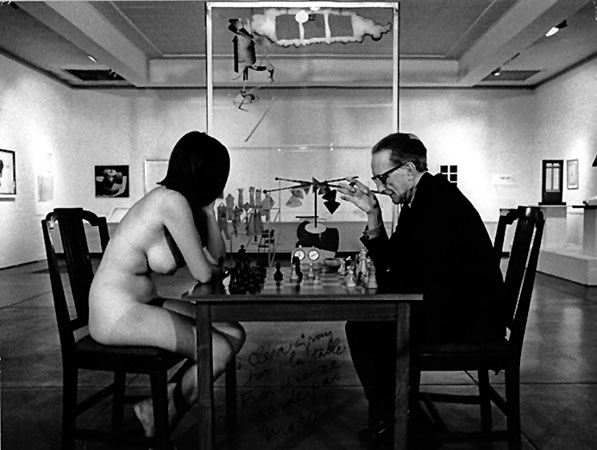
For more on Duchamp the Chess Player I heartily recommend watching the excellent and enthralling Jeu D'Échecs Avec Marcel Duchamp (1963) from UbuWeb's extensive video archive, in which the artist plays the game with avant-garde composer Edgar Varese and discusses his work.
For more on Duchamp's Problem With No Solution click here.
The rigor and intensity of this endgame problem stands in sharp contrast to the means by which Duchamp presents us with a hint of its solution: a cupid aiming his arrow toward the ground (or into the sky, if we consider that the cupid is presented upside-down). Cupid is, of course, the mythological god of love, and his arrow is usually aimed in the direction of an amorous target; a direct hit can cause the recipient to fall deeply and blindly in love. Knowing this, and knowing that when Duchamp designed this brochure he had recently met and fallen in love with Maria Martins— a Brazilian sculptor, married with three children, and in almost every respect, unattainable—one is tempted to speculate that Duchamp might have had a personal situation in mind when he decided that a cupid should indicate the path to follow in pursuing a solution to this vexing problem. Duchamp was well known for having said: “There is no solution, because there is no problem.” In the end, the problem that he faced with Maria Martins was insurmountable, demonstrating that in both chess and life— and perhaps in art as well—there are, indeed, problems without solutions.Problems which are, never-the-less, compelling, all-consuming and deeply engrossing.
For more on Duchamp the Chess Player I heartily recommend watching the excellent and enthralling Jeu D'Échecs Avec Marcel Duchamp (1963) from UbuWeb's extensive video archive, in which the artist plays the game with avant-garde composer Edgar Varese and discusses his work.
For more on Duchamp's Problem With No Solution click here.
Subscribe to:
Posts (Atom)

 Posts
Posts